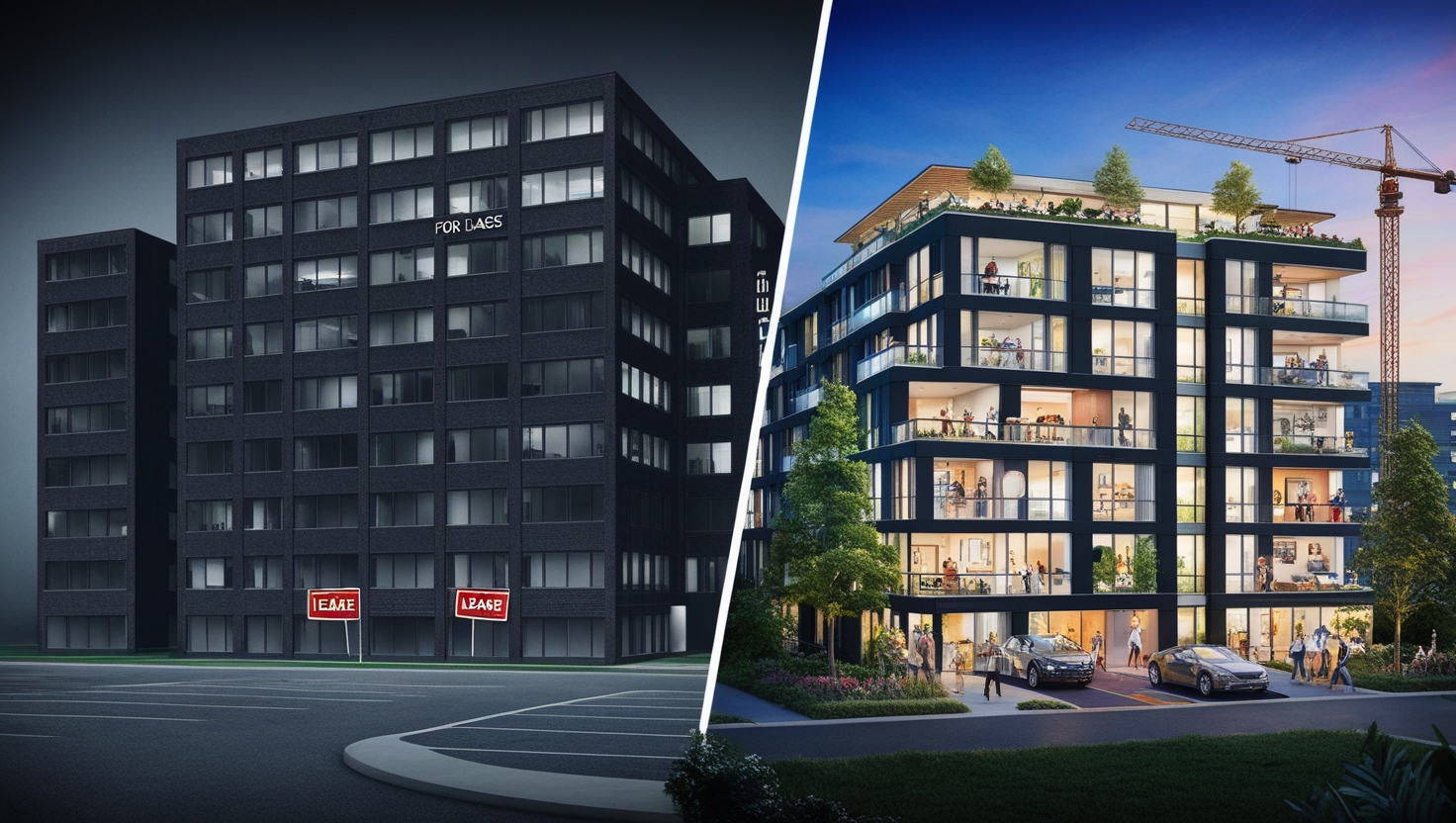
 The remote work revolution has left a gaping hole in commercial real estate that some have filled with residential units as a promising solution. The move is tempting considering there are vacant offices while housing demand is skyrocketing against limited supply which continues to fuel home prices.
Converting vacant office properties into residential units seems logical with a profitable potential for landlords, developers, and investors looking to drive the performance of underutilized assets. However, the transition from office to residential properties, while conceptually appealing, poses challenges that demand careful consideration.
The Challenge Ahead for Office-to-Residential Conversions
One of the larger, more costly challenges we’ve seen with clients in converting an office is retrofitting the infrastructure to meet the requirements of a residential dwelling.
Office spaces are configured differently than apartments when it comes to utilities. Typically, there’s a limited kitchen and a central location for the bathrooms in an office building so converting the plumbing to a residential structure will likely require additional water heaters, metering water for each unit, and even reconfiguring the plumbing so each unit has its own showers, toilets, sinks, and drains. Reconstructing the hot water distribution to meet housing needs might require gutting the building to its exterior shell.
Electrical mapping also poses a significant obstacle in the re-design because each unit needs to have adequate power and the ability to be individually metered. Office buildings generally have a shared central HVAC system, so consider the efforts to right-size each unit for its own HVAC system. If systems can’t be separated, billing for utilities can be tough to distribute properly among residents.
From an overall design perspective, the transition from offices to homes presents its own set of challenges. Office spaces are typically shallower than residential units, so they will require creative reconfigurations to evoke a homely ambiance.
And then there are logistical hurdles in office conversions, ranging from parking and zoning laws to structural engineering and compliance with fire and safety regulations. What’s considered adequate parking designed for office use, when some employees carpool instead, may fall short when residential tenants have multiple vehicles that require more parking space.
There are also vastly different zoning laws depending on the area and local government requirements. Thorough research is required to ensure the municipality will allow residential use, and if they will, what effort and expense, will be required to get approval and subsequent additional fees that may be required for permitting the reconstruction.
Structural modifications to meet building codes and accommodate residential layouts further compound the complexity of the conversion process. In particular, the age of the building and jurisdiction play a critical factor in the types of modifications that will be required.
The Greater Potential for Office-to-Residential Conversions
Despite the challenges in converting office space to residential units, there are opportunities for landlords, developers, and investors. The key to this is in the execution.
For example, elevator shafts can be repurposed to accommodate additional infrastructure. The type of commercial property, such as a hotel, could offer a comparatively smoother transition to residential housing compared to converting an office space. Even smaller historical buildings can sometimes be better sized and more accommodating to a residential conversion.
In many cases, minor structural changes, such as building on top of the roof, may allow for additional floors, giving developers the chance to increase the number of units and possibly even create and design “premium” top-floor units.
While office conversions can be expensive, it’s worth exploring available credits and incentives — particularly in cities where there are greater office vacancies — which can help alleviate costly renovations.
The timing to execute a conversion also plays a critical factor because vacant office spaces are typically market-ready compared to ground-up construction, so there’s greater potential to expedite the timeline to completion. This makes it an attractive option for those seeking faster returns on their investments.
The journey from vacant offices to thriving residential communities can pose some pitfalls, yet it is ripe with potential. By thoroughly assessing the current structure against its potential, leveraging available resources, and skillfully navigating the regulatory landscape, stakeholders can breathe new life into office spaces that once stood dormant.
About the Author
Alan Baron is an Enterprise Managing Consultant with RealFoundations. He has over 30 years combined experience working and serving clients in the homebuilding, construction, development and property management market sectors, implementing systems and streamlining business processes for companies with residential, retail, commercial and marina assets. Alan’s extensive experience in construction accounting and property management technology, along with his hands-on experience in facilities management, tenant coordination, acquisitions, corporate accounting, budgeting, projections and finance provide the platform to deliver exceptional results in the areas of process improvement and system design.

Alan Baron
Enterprise
Managing Consultant
View Bio
About RealFoundations
RealFoundations (RF) is the world’s foremost professional services firm focused solely on the real estate industry. Through our delivery of Management Consulting and Managed Services, we help companies that develop, own, operate, service or invest in real estate make better, more profitable decisions. We are proud partners to over 500 real estate companies around the globe, providing accelerated solutions that solve some of real estate’s most complex challenges. We Make Real Estate Run Better.