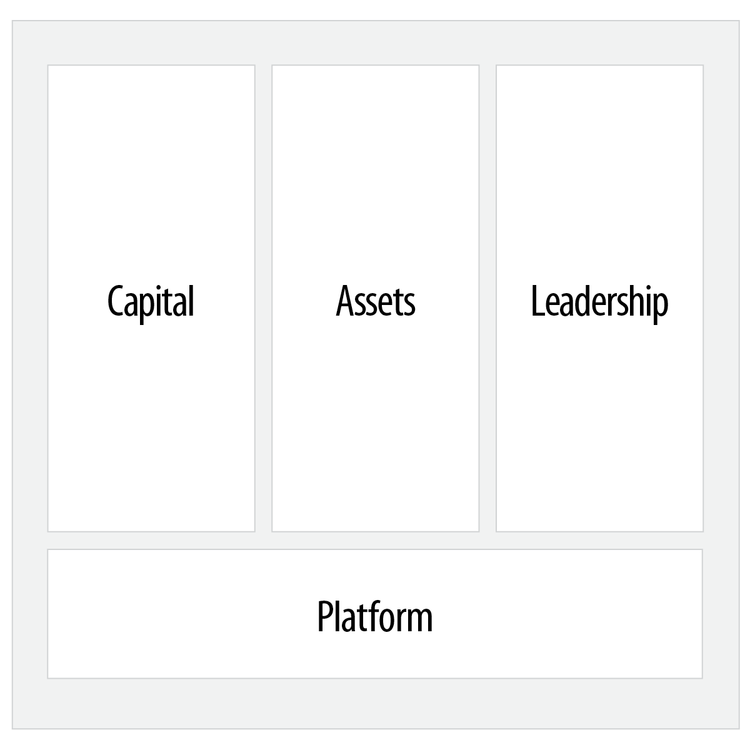
Capital
Decisions about types of capital needed; sources; restrictions; durations; and expected returns.
Assets
Decisions about investment types; asset types, sizes and quantity; and geographies.
Leadership
Decisions about experience and capabilities of key individuals; track record as a team; and roles filled in the enterprise.
Platform
Decisions about work that will need to be done to operate the enterprise; information needed to run, measure and manage all work; tools required to support or automated the work; resources used to perform the work; and mechanisms to continue to improve operations once running.
Strategy
Overall strategy, business goals, operating principles, and success criteria to define the demands and expectations that the TOM must satisfy.
Functional Model
A map of all work performed by or for the organization – the activity required to execute business goals, used to confirm tasks and activities that constitute a function.
Sourcing Model
Primary sourcing strategy and decisions; and management hierarchy to operate the model both within business and with external service providers, used to provide clarity and accountability.
Information Model
The data, information and applications to operate the business, used to define the rules, operation and relationship between sourcing, processing and delivery of data.
Improvement
Mechanisms by which operational improvements are prioritized and delivered, used to: deliver changes to the TOM that support evolving demands of business strategy.
Functional Governance
How do we know that work is being defined and measured in a consistent manner? How are the changes to the work governed and communicated?
Functional Measures
How is the work being done measured and reported on?
Work Map
Describes all the work done by and for the enterprise, without regard to sourcing decisions or org chart.
Functional Connectors
How is the work related to other components — to articulate who is doing the work; what tools are used to do the work; and what information is needed for and created by the work?
Sourcing Governance
How do we know that our internal personnel and hired service provider people are adhering to, and being managed according to, established enterprise standards?
Sourcing Measures
How are our people’s performance being measured and reported on?
Resource Map
Describes the total enterprise organizational chart – including both internal teams and externally sourced providers.
Sourcing Controls
What formal controls on managing our resources require definition, communication, and periodic auditing/checking?
Controls Environment
How do we know that information is being created and used according to known and controlled processes? How is data quality risk being managed?
Information Governance
How does information support the mission? What does data mean? How do we know we are getting it at the right level, at the right time and with the appropriate quality?
Business Measures
How are the results being achieved and the work being done measured and reported on? How are common metrics defined and built?
Data Model
What exact data is needed to measure performance and control the work and the assets? Where is it created, stored and altered?
Digital Map
What tools are needed, what do they do and how do they interact with each other?
Data Movement
How does information get from out there to in here in a transparent, controlled and usable way?
Information Suppliers
Who provides information? Do they know what they need to provide and when? Is there a mechanism to monitor and improve that supply?