January 2019 | Insights From the CEO – For a good long while (say, 80s thru 00s) the strategy for an R/E venture followed a consistent and familiar script. First: There is an opportunity with this specific asset class (residential in California, medical office, upgrading industrial to logistics, multi-family in the southeast). Then: Here is where the capital will come from and how it will be structured. And finally: Here is the leadership team that has done this before (or something like it) and is ready to do it again. Think back on the hundreds of decks and presentations you’ve seen; most followed that script. The holy trinity of real estate strategy topics: capital, assets and leadership.
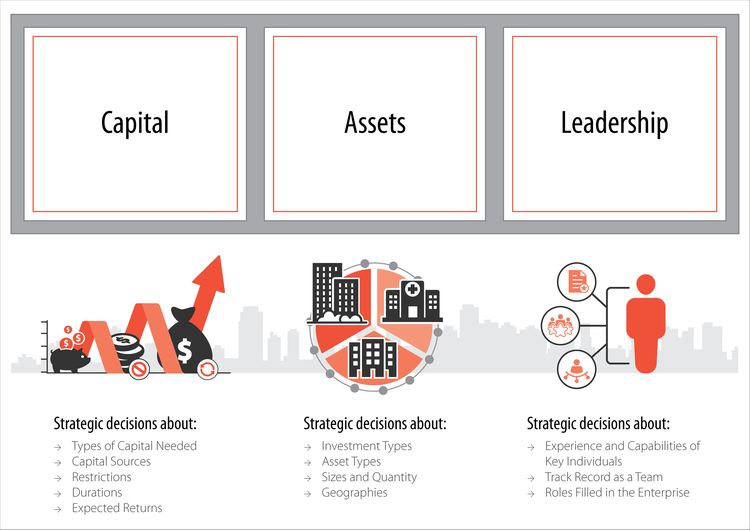
Everything else — about HOW that strategy would be carried out — would flow from (or was implied by) those three things. Leadership would hire some people; then those people would hire some people and buy some systems. Pretty soon there would be a whole organization to do the tactical and operational work to carry out the strategy. That organization would BE the operating platform. That platform would be expressed in an org chart (with all of its attendant titles, position descriptions, departmental groupings and reporting lines). And if the firm had forward-thinking technology people, there might also exist a complex diagram with boxes and arrows that depicted a ‘technology architecture’.
Three Becomes Four
As portfolios got bigger, geographical reach increased, and capital structures became more complex, the platform ‘strategy’ of ‘hire a bunch of people and have them figure it out’ no longer worked. Increasingly it made sense for some other enterprises to do some of the operational work: JV partners, service providers, outsources. So leading enterprises started to include the design of the operating platform in the strategic discussion along with capital, assets and leadership.
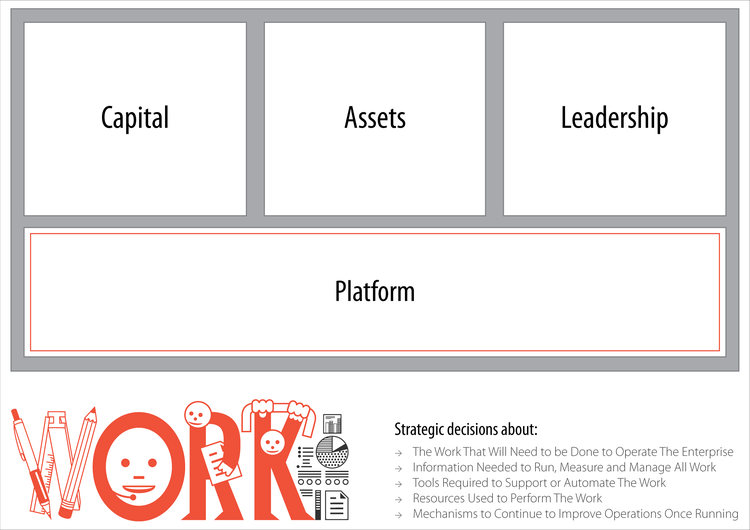
Leading enterprises realized that the operating platform itself deserved to be ‘elevated’ — that it deserved ‘strategic consideration’ alongside Capital, Assets and Leadership. Questions that formerly might have been overlooked as ‘just execution detail’ began to get the strategic attention they deserved:
- What work must we do?
- How should we resource our needs?
- What information will we need?
- Where will the information come from?
- What tools will we need?
- How will we govern the work, the resources, and the information flows?
These questions — and their deeply interconnected answers — are increasingly recognized as forming the heart of the ‘Platform Strategy.’
The Dynamic Operating Model
Depicting the strategic frame around how an enterprise will operate needs a richer vocabulary than the age-old org chart provided. And so we’re increasingly seeing a patient, strategic approach to designing and modeling the operating platform replacing the “just do it” approach.
And, since all matters of strategy must evolve with and in response to the changing practical needs of the business, leading r/e enterprises increasingly recognize that defining the operating model is not a static, ‘once-and-done’ exercise. A robust operating model offers a framework and method for responding to big changes in the competitive landscape:
- We just bought a portfolio in a new geography — how will that portfolio work?
- We acquired a competitor — how will we stitch the legacy firms together into an effective, efficient whole?
- We see the world of technology changing constantly — how can we be sure we’re not left behind?
- We see the emergence of specialist service providers — how can we use them to improve our bottom line?
- We need to make complex investment decisions — how can we bring all of our collective (but distributed) knowledge to bear on our decision-making process?
- Our investors are getting increasingly demanding, both during the diligence phase and throughout the lifecycle of the partnership – how can we efficiently satisfy their information needs?
Of course, there is a long, long list of such questions. Tackling them with the aid of a thoughtfully constructed and actively maintained operating model is far better than not (and RealFoundations can help you)!