
February 2021 | Insights From Our Multifamily Experts – If Multifamily (MF) owners/operators have not already taken steps to compete with the single-family rental (SFR) sector more effectively, they may want to make 2021 the year to bolster their operational capabilities.
In recent years, SFR has solidified into a promising and institutionalized investment asset class. A study published in 2018 by the National Bureau of Economic Research showed that more than 12 million single-family homes in the United States were being rented. An Urban Institute analysis the same year found that SFR was the fastest-growing facet of the U.S. housing market and was poised for continued growth.
That forecast has proven accurate, according to Dana Hamilton, Senior Managing Director and Head of Real Estate at Pretium, the nation’s second-largest owner/operator of single-family rentals. “There are between 15 million and 16 million existing single-family rental dwellings in the U.S.,” Hamilton told Multi-Housing News in late 2020, noting that represents “more than 12 percent of all U.S. housing, making the single-family rental industry comparable in size to the 10-unit-plus multi-housing market.”
As SFR has taken off, it has become more disruptive to the multifamily sector. In many regions, SFR and MF owner/operators are competing with one another to varying degrees for the same residents. This is particularly the case in the Sunbelt and Southwest regions where land for SFR development is more available and less costly than in major coastal urban areas. However, MF companies can make adjustments to soften SFR’s impacts on their business.
SFR’s Genesis and Evolution
To better comprehend how the MF sector can respond effectively, it helps to understand SFR’s genesis and ongoing appeal. SFR is an outgrowth of the Great Recession of 2007-2009 when investors scooped up hundreds of thousands of distressed single-family homes around the country for pennies on the dollar and converted them to rental properties. Since then, demand for SFR housing has been strong because many people still want the “American Dream” of living in a house but are unable to afford or uninterested in ownership for a variety of reasons (e.g., poor credit rating, student loan debt, lack of savings, preference for housing flexibility or a maintenance-free lifestyle). Renting a home is the next best thing.
Over the years, though, existing single-family housing stock for acquisition and SFR conversion has become much scarcer. This has spawned the build-to-rent (BTR) segment within the SFR sector. BTR refers to purpose-built single-family rental homes in planned communities. The BTR segment now is booming, attracting not only renters but also an interesting mix of industry participants including some of the biggest names in homebuilding, property management and real estate investment.
Demand for SFR has been coming from a handful of demographically diverse residents who, despite their differences, seek the same thing in housing. While they do not want to own a single-family home or live in an apartment, they do want a spacious house and private yard in communities rich with multifamily-type amenities such as pools, tennis courts, parks, etc. These groups include: millennials with young families who cannot afford home ownership; previous single-family homeowners going through a life transition (relocation, marriage, divorce or death of a significant other); downsizing empty nesters who want a comparable but care-free quality of life; and people of all ages who can afford to buy and own but have other priorities for their money.
Since the pandemic started, SFR demand has accelerated across a broader cross-section. People want more space – they are now working from home (and some may continue doing so even after the virus is under control) while their kids are “attending” school virtually in the living room. Also, many want to escape the density of urban apartment living to reduce their exposure to infection via public transportation as well as shared lobbies, building hallways, elevators and stairwells. SFR typically offers more square footage and bedrooms along with privacy and a greater ability to maintain social distance.
Growing Competition for the MF Sector

Consequently, SFR is siphoning off MF residents. A recent survey of single-family rental operators in 55 metros is indicative. The findings, presented by John Burns Real Estate Consulting at December’s IMN Single Family Rental Forum (West), show that in Q3 2020, 32 percent of new SFR residents moved from MF properties, with 59 percent coming from urban areas. The survey also reports a 97 percent occupancy rate for SFR properties and notes the need to build more stock.
Not surprisingly, several leading homebuilders, while still mainly focused on building and selling single-family homes, are also dipping into the BTR and SFR markets. They include Lennar, DR Horton, LGI and Taylor Morrison. Toll Brothers, the luxury homebuilder, has jumped in significantly, making a $60 million investment in a joint venture with BB Living, the Phoenix-based BTR development company. In addition, there’s a convergence of players merging all platforms (SFR, MF, and BTR).
Major institutional players are investing, as well, in both traditional SFR and its BTR offspring. Invitation Homes and Rockpoint Group recently established a $1 billion joint venture for the acquisition and operation of SFR properties in the western and southeastern United States. Tricon, which owns and manages 30,000-plus SFR homes and MF units nationwide and in Canada, has formed a $450 million joint venture with a large U.S. pension fund to develop BTR communities.
SFR builders and investors alike are learning important lessons from the MF sector such as how to amenitize communities so they deliver the lifestyle experience today’s renters seek. They are using multifamily applications, property management systems and screening practices. However, these solutions generally do not meet all the needs of the SFR sector, so most organizations have created their own applications in-house or purchased point solutions to serve the business needs specific to SFR. As the market matures, we can expect the development of more complete and robust solutions specifically for this asset class, particularly for revenue management.
While SFR competition is growing, the MF sector is facing other pressures. Since the pandemic started, rent collections were lower in 2020-’21 than in 2019, mostly due to recession-related resident job losses. MF residents tend to work in industries that are less recession-proof than homeowners and SFR renters. Rent collection over the course of the pandemic has been less of a problem for SFR companies, which cater to a more middle and upper-middle-class, dual-income demographic.
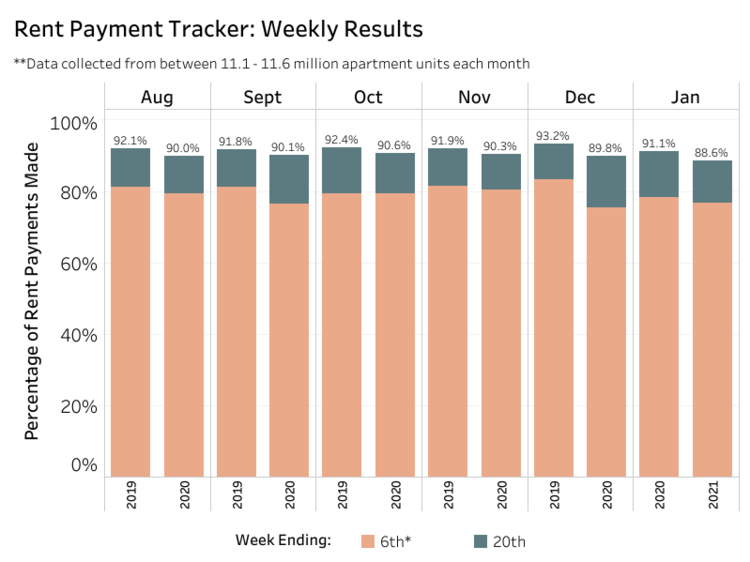
NMHC Rent Payment Tracker
Additionally, as noted by Green Street Advisors, at the start of the latest economic downturn, the multifamily pipeline was very full with a two-year supply of inventory needing to be absorbed. This has weakened landlords’ pricing power. Green Street is actually forecasting a 6 percent drop in multifamily NOI for 2021, more than in earlier recessions.
The challenges of rent collection, absorption and ultimately flat or declining NOI are exacerbating and make it all the more urgent that MF owners/operators act promptly to mitigate the disruption caused by the single-family rental sector.
Proactive Steps for Multifamily Owners/Operators
SFR cannot be an afterthought for MF owners/operators. It now is a formidable competitor that MF companies must factor into their plans. They must re-evaluate and make changes to their pricing, technology, marketing, operations, and work sourcing strategies in light of today’s different landscape.
Pricing
MF owners/operators should know the rental rates for SFR homes in markets where they are competing for residents against single-family properties. They must conduct competitive pricing analyses – just like they would for other MF properties in the same market – and factor this data into their pricing strategy. This is especially important in markets where the MF owner/manager has properties with larger units, e.g., three or more bedrooms, which are more competitive with SFR offerings. Additionally, AI and machine-learning-equipped pricing technology that proactively anticipates human behaviors, based on a resident’s history of interactions, along with market data can be leveraged to assist with driving revenue as well as resident retention.
Technology
MF companies should invest in technology solutions to provide a Customer Experience (CE) equivalent to SFR. Tech-enabled self-guided tours for prospective residents – a widespread practice in the SFR sector (and certainly a necessity during the pandemic) – should now be the MF norm. Also standard in apartments should be smart home features such as remote access, keyless entry and temperature and light management, plus high-tech security systems. Greater use of AI can help with responding to calls and texts 24/7 for things such as leasing, maintenance requests and emergencies.
Marketing
With many people working and schooling from their apartments at this point, MF marketing initiatives should showcase the multi-functionality of space in and outside of the unit such as lofts, dens, open outdoor areas and business centers. MF owners/operators leasing two-bedroom plus den and three-bedroom units should prominently spotlight that offering because it is less commonplace for apartments but makes them more competitive with SFR properties. Marketing also should promote both traditional and newer amenities and services that are not always available in SFR communities. These include pools, fitness centers and clubhouses as well as package lockers (which ensure that delivered items are not stolen from the front porch). Apartment buildings/complexes in good school districts will want to publicize that, too, especially if that is one of the few compelling differentiators for nearby SFR properties. After prospective residents take self-guided tours of apartments, complement the experience with timely, personalized leasing agent follow-up.
Operations
In addition to wanting smart home technology, many renters want a pet-friendly environment, convenient laundry and more space which are typical of SFRs. Capital additions of onsite dog parks, in-unit laundry or separate workspaces add the value that renters are seeking. Strengthening retention is also important – offering incentives for longer lease terms can help. Enabling residents to have rent payments reflected on their credit report to help them build a good credit history is advantageous to both the resident and owner. When residents need to move across town or the country, make relocation easy with seamless transfers to other company-owned properties. This also supports and strengthens brand awareness and loyalty.
Resources
MF companies can learn from the SFR work sourcing model which includes outsourcing some key functions to third-party strategic business partners. They should evaluate the traditional MF model of having full-time employees at every property and consider switching to alternative approaches for increased flexibility, reduced expenses and improved customer satisfaction. One example is using outsourced maintenance staff to serve multiple properties and even having that staff dispatched by a central call center (which could be operated internally or externally).
RealFoundations Can Help
Multifamily owners/operators today are facing new but surmountable challenges. They should be preparing for stiffening competition from the expanding single-family rental sector on top of stagnant or negative NOI and occupancy growth in coming years, largely due to COVID-19. Their go-forward action plans must account for these realities and include modifications to how they operate across multiple functions.
Granted, this entails a significant undertaking for MF organizations, large, small and in between. While some companies will have the expertise and bandwidth to make the changes, others may want to tap an outside real estate consulting firm. RealFoundations can assist MF owners/operators with the implementation of specific business process improvements including but not limited to optimizing revenue management, marketing plans and technology strategy. For owners managing both MF and SFR asset classes, we can assist with strategies to optimize their business processes, workforce and technology stack for effective management of and reporting on both asset classes.
Connect with Us
To learn more about this topic, contact Senior Managing Consultant Hope Dunleavy by email or +1 720 259 2010.
About the Author
Hope Dunleavy is a Senior Managing Consultant with RealFoundations. She has over 20 years of diverse experience in the real estate industry, focusing primarily on Commercial and Residential Owner/Operators. Hope is an experienced property management and real estate professional with information technology, accounting, sales and training experience. Hope has demonstrated success in the following functional areas: project management, vendor management, information technology process and people management, business process improvement and system implementations.
Hope has been responsible for the planning and management of strategy, diagnostic, change management, system selection, and system implementation projects during her tenure at RealFoundations. Her clients include Walmart International, Carmel Partners, JLL, Waterton, Western National Group, Harbor Group and Kimco.
About RealFoundations
RealFoundations (RF) is the world’s foremost professional services firm focused solely on the real estate industry. Through our delivery of Management Consulting and Managed Services, we help companies that develop, own, operate, service or invest in real estate make better, more profitable decisions. We are proud partners to over 500 real estate companies around the globe, providing accelerated solutions that solve some of real estate’s most complex challenges. We Make Real Estate Run Better.