Enhancing Efficiency, Cost Management, and Risk Mitigation in Multifamily Companies
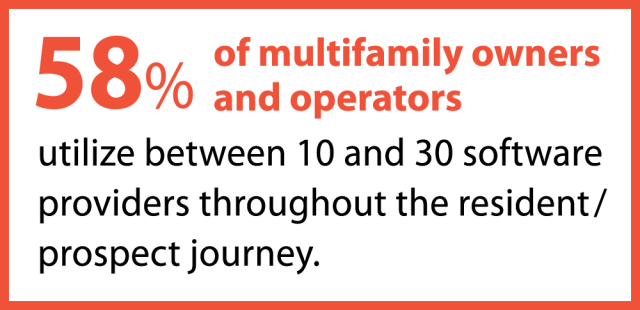 Multifamily property owners and operators are increasingly challenged by the proliferation of software solutions (“PropTech”) in the market. The surge in PropTech innovations over the past six to eight years, driven by substantial venture capital investments, along with poor internal governance, has led many organizations to lose track of their technology infrastructure. A recent survey indicates that 58% of multifamily owners and operators utilize between 10 and 30 software providers throughout the resident/prospect journey. While these new solutions—such as Fraud Detection and Self-Service Renewals —address specific challenges faced by property managers and their clients, they also contribute to heightened complexity, inefficiencies, inflated costs, and increased risks.
Common Complications
To address these issues, companies should actively pursue PropTech consolidation. This process starts with owners and operators evaluating their current technology stack to identify potential risks and inefficiencies. Below are five of the most common complications that arise from a disconnected technology platform:
Inflated Technology Costs
 One of the most evident drawbacks of a fragmented technology environment is overspending. When organizations employ multiple software applications that fulfill similar functions, they incur redundant costs—often paying for unnecessary technology. The lack of consolidation prevents organizations from leveraging scale with vendors, resulting in higher per-unit expenses. Additionally, managing multiple solutions can escalate support and training costs.
Data Privacy and Security Risks
 Poorly managed software environments also elevate security and privacy concerns. Each application typically operates with its own database and privacy protocols. Frequently, software vendors market their products to individuals who are not the primary decision-makers, which can lead to a disregard for established governance around software subscription management. This often leaves the IT and Risk Management functions within a company unaware of the complete tech stack in use, leading to potential mishandling of personally identifiable information (PII). Such decentralization hampers these function’s ability to manage risk effectively and comply with data privacy regulations.
Inefficiencies and Reporting Complexities
 According to the 2023 Customer Experience Technology Report, the primary objective for the majority of operators is to implement new technology that enhances operational efficiency. The survey also highlights that the management and integration of numerous technologies presents significant challenges. A decentralized technology stack adversely affects overall operational efficiency at both the site and corporate levels. Inadequate data governance can result in disparate data repositories, compromised data integrity, and a lack of automated integration capabilities. These challenges make it difficult to generate accurate financial reports and comprehensive enterprise analytics, ultimately obscuring insights into portfolio performance. Without effective reporting mechanisms, owners, operators, and investors may find themselves lacking critical information regarding a portfolio’s financial and operational performance.
Customer Experience Implications
 The latest NMHC and Grace Hill Renters Preferences Survey revealed that residents increasingly embrace technologies that enhance convenience, such as smart home devices and resident portals. However, concerns have arisen regarding the growing number of applications required to manage various aspects of the rental experience. Many residents find it inconvenient to navigate multiple platforms, which can detract from customer satisfaction and engagement. A preference exists for a streamlined and integrated platform that consolidates functions. Additionally, prospective renters value a seamless, integrated application process that minimizes the time between submission and acceptance.
Inability to Fully Harness AI
 AI requires access to consolidated and accurate data. Companies that are interested in leveraging their enterprise (non-public) data for AI use cases will struggle when the data is stored in multiple disparate databases and systems. Similar to the challenges faced by companies to produce accurate reporting across multiple disparate databases, enterprise data will need to be consolidated in order to fully leverage AI technology across a single data lake.
The Solution: Consolidate PropTech for Business Success
The first step in addressing this issue is understanding the extent of the PropTech solutions that a company has in its ecosystem. RF has the automated tools to help companies conduct a complete inventory of their PropTech by leveraging the purchasing data available within the companies’ financial system of record. Once an inventory is created, RF can help identify those tools that represent opportunities to consolidate.
To explore how RealFoundations’ approach to PropTech consolidation can improve efficiency, reduce costs, and minimize security risks, we invite you to engage with our experts. Together, we can identify software redundancies and streamline your technology infrastructure.
About the Authors
Hope Dunleavy is an Enterprise Managing Consultant with RealFoundations. She has over 25 years of diverse experience in the real estate industry, focusing primarily on commercial and residential owner/operators. Hope is an experienced property management and real estate professional with information technology, accounting, sales and training expertise. She has demonstrated success in the areas of project management, vendor management, information technology process and people management, business process improvement and system implementation.
Ray Thornton is an Enterprise Managing Consultant at RealFoundations and has over 20 years’ experience aligning residential real estate business strategies with technology solutions. Ray specializes in residential real estate operations and has held primary responsibility for many ERP transformation, process improvement and technology alignment initiatives, serving as a valued advisor to both internal and external stakeholders. He has deep experience with solution design and configuration, data migration, and consolidating technologies into a unified, centralized platform to maximize efficiency and improve performance.