“Working Out Loud” (WOL) describes new ways of bringing social collaboration and narration techniques into the workplace. It can be defined with a simple formula: WOL = Observable Work + Narrating Your Work. “Observable Work’” means putting work in a place where others can have the benefit of seeing and potentially engaging with it to inform their own work. “Narrating Your Work” means providing context for the observable work so others can determine its applicability to their own projects.
Working Out Loud
The business case for WOL is strong and gaining velocity every day in a world of exponential data proliferation. Currently, an astounding 2.5 Quintilian bytes of data are produced every day, according to Domo, a computer software company that specializes in business intelligence and data visualization. The pace is only accelerating as the Internet of Things continues to grow. By 2020, Domo predicts 1.7 MB of data will be created every second for every person on the planet.
Complicating matters further, more than 90 percent of data at this point is in the form of emails, text messages, images, videos, conversations, online meetings, calls, graphics, presentations, stories, etc. This is contextual data —versus tabular or structured data recorded in a table or database. Leaders at companies of all sizes rely on contextual data to make key business decisions, so this information really needs to reside someplace that’s organized and easily accessible. WOL enables this. Of course, the larger a company is, the more important it is to work out loud because the organization presumably is producing more data containing actionable intelligence.
WOL also can help capture the knowledge inside the heads of team members wherever they’re located and whatever their role within the organization. It’s not enough to just hire talented professionals and let them do their work — the organization needs to know and share what everyone is working on, how they’re doing their work and what they’ve learned. Others in the enterprise could use that information to excel in their own work and make the company more successful.
Working Out Loud lets people:
- Quickly find answers to questions – They have easy access to knowledgeable colleagues and valuable information that the organization has captured.
- Read fewer emails – They’re continually communicating and sharing through other newer and more collaborative technologies, creating threads that capture historical and ongoing conversations, e.g., Teams, Yammer, Slack, etc.
- Forge strong and highly productive professional relationships – Via these newer technologies, they can simply connect, in real-time, with colleagues anywhere in the world who have similar professional interests and/or relevant knowledge.
- Attend fewer meetings – They can mine historical conversations for information and perspective in order to make quicker, well-informed decisions, reducing the need for verbal discussions either in-person or remotely via video or voice call.
- Work whenever and wherever – They’re able to access cloud-hosted technologies 24/7 regardless of their location and time zone to create, process, access and act upon information.
- Establish personal brand recognition – They can showcase what they know whenever they want to do so.
- Have greater transparency into their organization’s work – Everyone can participate by sharing information and ideas.
Companies that figure out how to find and leverage both their contextual data and what employees know will be more successful than those that do not. Companies perform better when they know what they know and can apply what they know to their business today and in the future.
Implementing WOL Technology
WOL requires the right technology infrastructure. The organization needs to move emails, chats, meetings, files, plans and other content into an enterprise social collaboration tool. Not surprisingly, the demand for these tools is growing. The global market for enterprise messaging and collaboration solutions was expected to reach $2.4 billion in 2018, up nearly 12 percent from the prior year, and is forecast to hit $3.2 billion by 2021, according to International Data Corp., a leading global market intelligence firm.
Among the most popular solutions today are Microsoft Office 365 (O365), Slack and Workplace by Facebook. If an organization is a Microsoft (MS) customer using Outlook, Excel and other MS functionality, it may already have access to all or most of what’s needed for WOL, especially if it has licenses for other components of the platform (e.g., Yammer for discussions and Teams for collaboration). In this case, working out loud might not require buying more technology, although the enterprise would still have to invest manpower and time in determining how to set up and utilize the collaboration ecosystem, and also how to get all employees to switch over and ultimately embrace it.
RealFoundations (RF), one of the world’s leading professional services providers focused exclusively on the real estate industry, has created a robust WOL ecosystem within its instance of O365. RF has adopted tools and places within the MS cloud-based system as its “space” for working out loud. The firm’s 400-plus employees in nine offices worldwide work out loud every day — it’s just how they operate. They share and/or collaborate on different types of content (documents, photos, videos, URLs, conversations), conduct advanced searches (e.g., using Bing for Business to find knowledge across Yammer, Teams, SharePoint, Stream and Outlook) and utilize social network functionality (like, comment, share, etc.). The graphic below illustrates the tools that company employees use to generate content and the places where the content “lives” and is available for enterprise-wide interaction and collaboration.
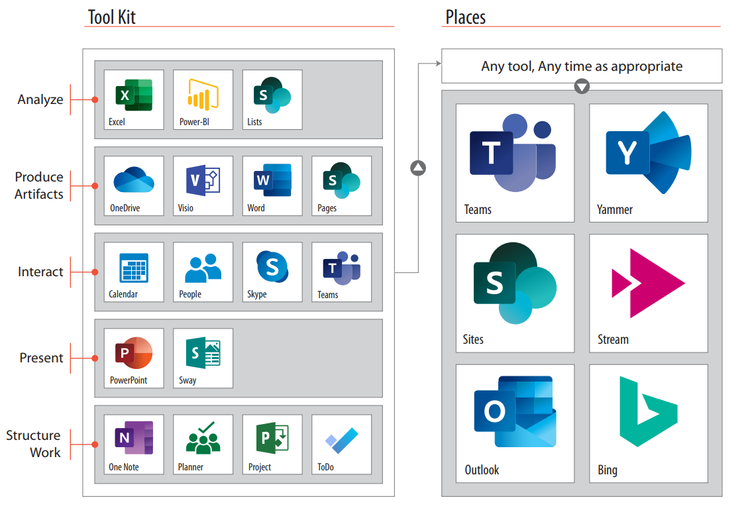
The Representative Tools and Places in Office 365 that RealFoundations uses to Work Out Loud.
The Role of Corporate Culture
Equally important as having appropriate technology to support WOL is having the right corporate culture across the enterprise. Collaboration and knowledge sharing must be the mantra. That’s certainly the case at RF where employees are evaluated during their bi-annual performance reviews on how much they work out loud and the quality of their WOL activity.
Leading collaborative organizations tend to believe all or most of the following foundational principles and any company considering adoption of a WOL approach should likewise be on board with these beliefs.
- The content within exchanges — emails, text messages, meetings, calls, conversations — have value beyond the moment and to more people than those who are part of the in-the-moment exchange.
- Outside of work, virtually every working professional has significantly changed how s/he communicates, converses, meets and exchanges ideas and interests over the past decade. These changes outside of work can have a positive impact inside the work environment.
- These changes also are impacting the speed with which information moves and the very nature of how we process and act on information.
- What everyone inside an enterprise “knows” is vastly larger than what the enterprise “knows it knows.”
WOL First Steps
Ready to start working out loud? Make sure there’s a solid commitment from the leadership team and a willingness to model the right behavior — senior executives must work out loud themselves and encourage others to do the same. Employees, too, will need to be dedicated to fully exploring and trying all the capabilities of their new WOL ecosystem — to be curious about and committed to figuring out how everything works.
The first steps should be to:
- Articulate the business goals for Working Out Loud;
- Clearly define and communicate the places designated for Working Out Loud (e.g., if using O365, Yammer is the company’s virtual water cooler and Teams is for defined projects, departments or efforts with a beginning, end and specific outcomes);
- Position WOL as just a natural part of working (the same as things we do in our personal lives every day, not something “extra”);
- Set clear expectations on engagement within each place (e.g., visit Yammer daily, keep Teams open and check it frequently like email);
- Define the benefits — “what’s in it for me” — at both the individual and enterprise levels; and
- Appoint WOL champions whose goal is to initially monitor and promote engagement with each place;